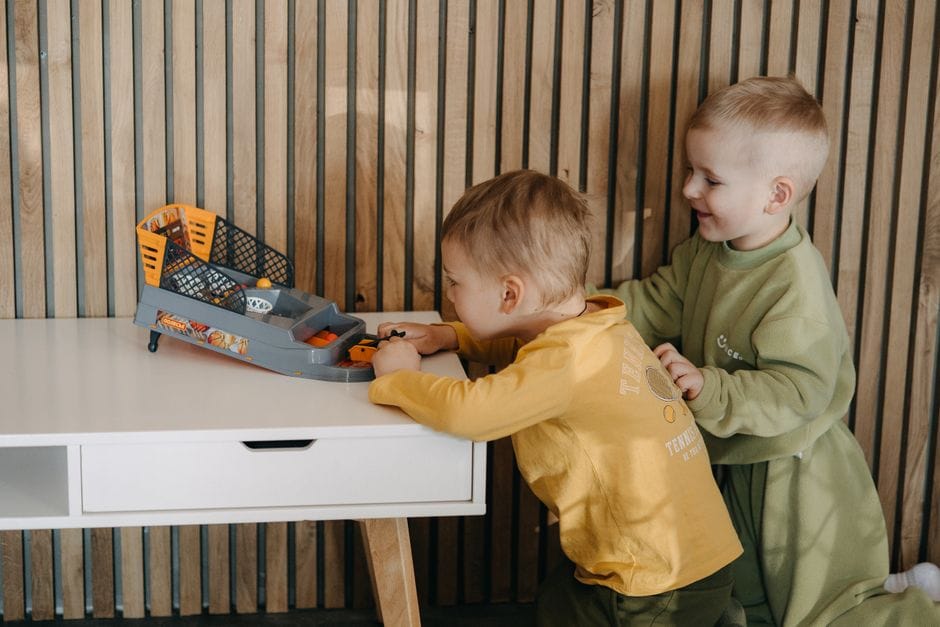
I used to say "share!" roughly four hundred times a day, like a malfunctioning toy, and it accomplished essentially nothing except making me feel like I was parenting. Two kids, one truck, instant warfare, and there I am chanting a word that, to a three-year-old, means "give the thing you want to the person trying to take it." Of course it didn't work. The breakthrough came when a preschool teacher pointed out that we were asking for the wrong thing entirely, and I switched one word for two.
"Share" is an abstraction; "take turns" is a plan
To a young kid, "share" is a fuzzy moral demand with no instructions attached. "Take turns" is a concrete sequence: you have it now, then he has it, then you again. One is a feeling you're supposed to summon; the other is a thing you can actually do. Kids handle the second far better because it has a shape, a beginning and an end, and it doesn't require a toddler to perform generosity on command.
The real shift is that turn-taking lets a kid keep something until they're done with it, and that security is what eventually makes them willing to hand it over.
How turns actually run in our house
We use a timer, openly and shamelessly. The same little Target kitchen timer that runs our homework also runs our truck disputes. The kid with the toy gets it until the timer dings — usually five minutes — and then it goes to the other. The timer is the bad guy, not me, and that distinction has saved my sanity. Nobody argues with the timer. They just glare at it.
What I've learned about making it stick:
- The waiting kid needs something to do, because "wait your turn" with nothing in their hands is just a countdown to a meltdown
- Some toys are nobody's to share — a special lovey, a birthday gift still shiny with newness — and protecting those is fair, not spoiling
- I narrate the handoff: "He's giving you a turn now," so the generous act gets named and noticed
That second point gets me side-eye from other parents, but I stand by it. Forcing a kid to "share" their brand-new birthday present teaches them that nothing is safe, which is the opposite of what makes a person generous later.
The version that's still messy
None of this turns siblings into a harmony commercial. They still fight; they always will, because fighting is partly how they figure out where one of them ends and the other begins. What turn-taking did was give them a tool they could eventually use without me, and last week I overheard my five-year-old tell her brother "you can have it when the timer beeps" entirely on her own. I stood in the hallway and did a small, quiet victory dance.