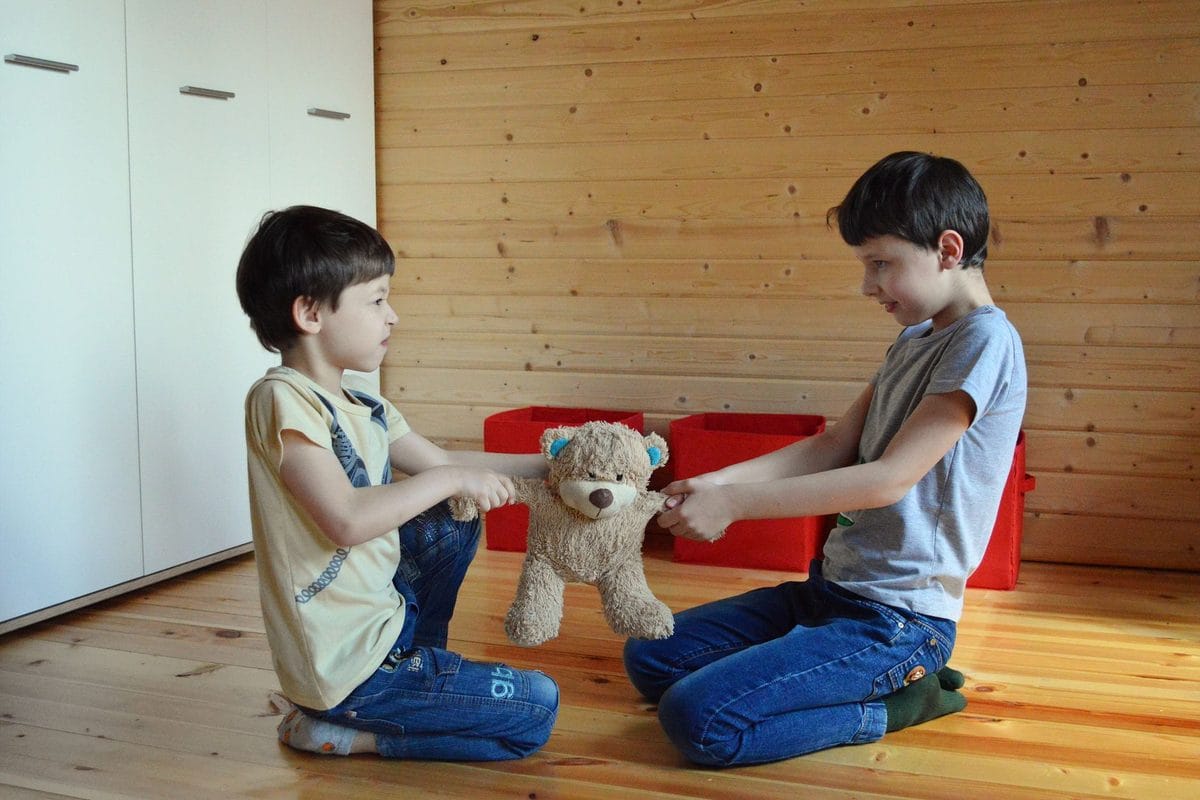
The fight started over the TV remote and ended with one kid crying in the hallway and the other insisting, loudly, that none of it was their fault. If that sounds like Tuesday at your house, you're not doing anything wrong — and you're also not the only parent wondering whether "normal" sibling friction has quietly turned into something else.
Why Two Kids in One House Almost Always Collide
Sibling rivalry isn't a parenting failure, and it isn't really about the remote control either. Susan Albers, a psychologist at the Cleveland Clinic, puts it plainly: "The feeling of competition is at the root of sibling rivalry." Kids read even small differences in attention, praise, or leniency as evidence that one of them is winning and the other is losing, and firstborns in particular often feel that pressure the moment a second child arrives and stays in the house. Age gap, temperament, and birth order all shape how intensely that competition plays out, and none of those factors are things a parent can rewrite after the fact. A five-year-old and a seven-year-old fighting over whose turn it is on the tablet is developmentally ordinary; it's the response to that fight, not the fight itself, that determines whether the relationship gets stronger or more bitter over time. None of it means the household is doing something wrong, and none of it means the fighting is a phase that simply needs to be waited out.
The American Academy of Pediatrics' parenting site, HealthyChildren.org, frames it the same way: siblings are going to fight regardless of how carefully a household is run, and what shifts with age is the subject matter — toddlers clash over toys and whose cup is whose, while teenagers argue about borrowed clothes, closed doors, and who told a secret. Parents who expect the fighting to stop once kids "grow out of it" are usually disappointed. It doesn't disappear. It just changes shape, and the skills a family builds around it at age six are the same ones that keep two twenty-five-year-old siblings speaking to each other at Thanksgiving. What a parent does in the middle-school years around borrowed clothes and slammed doors is really the same job as what they did at four around a shared toy — just with higher stakes and less patience on all sides.
The Reflexes That Make It Worse
Most parents' first instinct in a fight is to figure out who started it. Albers warns against that instinct directly — assigning blame and forcing an apology treats the fight as a case to solve rather than a feeling to work through (and it usually produces nothing besides a resentful "sorry" that nobody means). Comparing one child to the other lands even harder than it sounds like it would — "Why can't you just share like your brother does?" — and so does labeling: calling one kid "the responsible one" and the other "the wild one" locks both of them into roles they'll spend years either living up to or rebelling against. Albers' recommendation is to set a household rule ahead of time, no hitting, no name-calling, knock before entering a closed door, so that in the moment a parent can point to the rule instead of ruling on who was right.
Here's the part most parenting advice skips: treating both kids identically isn't the same as treating them fairly, and chasing perfect equality usually backfires. A ten-year-old and a four-year-old don't need the same bedtime, the same chores, or the same response to a meltdown — they need responses that fit where each of them actually is. Parents who insist on exact sameness end up either babying the older child or holding the younger one to a standard they can't meet, and both versions read to the kids as unfairness dressed up as fairness.
Different Ages, Different Needs
A four-year age gap doesn't erase competition — it just changes what the two kids are competing for.
With a wide age gap, the older child is rarely fighting over the toy itself; they're fighting for the amount of space the younger one takes up in a parent's day. That calls for protected one-on-one time with the older child specifically, not extra leniency toward the younger one to "make up for" being small. With siblings close in age, the dynamic flips — they're evenly matched, genuinely competing for the same resources, and more likely to need a parent to referee in the moment rather than after the fact. Neither pattern is a red flag on its own. Both just need a different response, and applying the wide-gap playbook to two kids eleven months apart (or vice versa) is a common reason advice that worked for one family falls flat in another.
What Actually Reduces the Fighting
Individual, undivided time with each parent does more for sibling peace than almost anything else in the research — not a big outing, just a recurring slot that belongs to one kid alone. HealthyChildren.org suggests something as small as a nightly bedtime chat or a regular dog walk with one child at a time, on top of a monthly or quarterly outing that's just theirs. Kids who get that reliably tend to compete less for attention in the moment, because they're not scrambling to prove they matter.
- Let a timer settle turn-taking disputes over a toy or a screen — five or ten minutes each, no negotiating mid-turn.
- Ask kids in advance how they want to be separated when a fight gets heated, and where their individual "corners" of the house will be.
- Hold a short weekly family meeting to set or revisit household rules, so discipline points to an agreed-upon standard instead of a parent's on-the-spot judgment call.
- Pick cooperative games over competitive ones during family time, or simply stop keeping score — this one alone changes the tone of an entire game night.
Skip the forced apology entirely — it's one of the clearest calls the research supports. Instead, once both kids have cooled off, ask each of them what they were feeling in the moment, separately if needed, and let an apology happen on its own timeline instead of on command. Kids as young as five or six can start learning basic negotiation this way: naming what they want, hearing what the other kid wants, and finding a version both can live with. That's a life skill, not just a sibling-management trick, and it transfers directly to friendships and eventually to first jobs, where nobody is going to force the other person to say sorry either.
When It Stops Being Rivalry
Most sibling conflict, even the loud kind, is reciprocal — both kids are somewhat equally matched, both are chasing attention rather than trying to hurt the other, and neither one is consistently on the losing end. Sibling researcher Corinna Tucker frames the useful diagnostic questions this way: Is physical violence happening past the toddler years? Does one sibling consistently "win," with the same kid always ending up on the losing side? Is there a real power gap in size, age, or cognitive ability being used against the smaller or younger one? University of Illinois professor Laurie Kramer, who studies sibling relationships, draws the line at chronic physical violence or repeated emotional tormenting — conflict that has stopped being back-and-forth and become one-directional.
That distinction matters more than it sounds like it should, because researchers including Mark Kiselica have argued that sibling maltreatment is under-recognized precisely because it gets waved off as normal rivalry. Watch for a child who seems afraid of a sibling, who becomes anxious or withdrawn, or whose eating or sleep changes around a specific sibling relationship — those are signs worth a conversation with a pediatrician, not something to wait out. Ordinary sibling friction, on the other hand, is not a five-alarm problem. It's tiring, it's loud, and on the right week it can make a parent question every decision that led to having more than one kid — and it is, almost always, exactly what it looks like: two people who are still learning how to share a house.