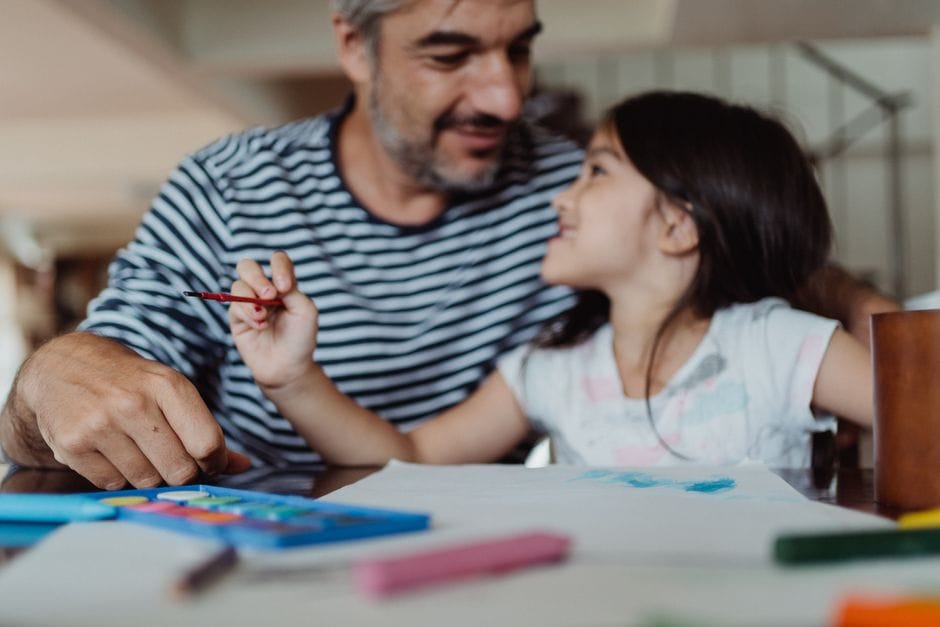
I praised my kids constantly, with the best of intentions, and for years I had no idea it might be doing anything other than building them up. "Good job!" "You're so smart!" "What a beautiful drawing!" It poured out of me automatically, the verbal equivalent of a participation trophy handed out every nine minutes. Then I noticed my daughter had started glancing at me after every small thing she did, waiting for the verdict, and it made me look harder at what all that praise was actually training.
The difference is who it's about
Praise judges the kid: "You're so smart." Encouragement notices the effort or the specifics: "You kept trying that math problem even when it got hard." It sounds like a tiny distinction, almost like splitting hairs, and it isn't. Praise teaches a kid to perform for your approval. Encouragement teaches them to pay attention to their own process, and the second one is the one that holds up when you're not in the room to clap.
The work of psychologist Carol Dweck on fixed versus growth mindsets popularized this, and you'll see it everywhere now. But you don't need the research to test it. Watch a kid who's told they're "so smart" hit something genuinely hard, and watch them quit fast, because struggling would mean they're not smart after all.
What it sounds like in practice
Switching was clumsy at first. "Good job" is muscle memory, and I caught myself saying it a hundred times before the new phrasing started coming naturally. The fix wasn't to go silent; it was to get specific.
Some swaps that became second nature:
- Instead of "You're a great artist," something like "You used so much blue in the sky — tell me about it," which keeps the kid talking and thinking
- Instead of "Good job cleaning up," noticing the actual thing: "You put every single block back in the bin"
- Instead of "You're so smart," pointing at the effort: "You figured that out by trying it three different ways"
Describing what you see, rather than rendering a verdict, does most of the work. The kid hears that you were actually paying attention, which lands very differently from a reflexive "good job" tossed over your shoulder while you check your phone.
I still slip, and it's fine
Let me be honest: "good job" still falls out of my mouth multiple times a day, and the praise police aren't coming. This isn't about banning a phrase or feeling guilty every time you cheer for your kid. It's about shifting the ratio so that more of what they hear points at what they did than at who they are. My daughter checks my face a little less now. She's started saying "I worked really hard on this" before I can say anything at all, which is the whole thing in one sentence.