Booking Seats That Actually Keep Everyone Together
The gate agent looks at your boarding passes, then at your three-year-old holding a stuffed rabbit by one ear, and delivers the bad news: your seats are 14C, 22F, and 31A, scattered across three rows because the flight filled up while you were still deciding on dates. It happens more often than it should, and it's almost always avoidable if you book with a little more intention. Since 2024, the Department of Transportation has pushed major U.S. carriers — American, Delta, United, Southwest, Alaska, and JetBlue among them — to guarantee free adjacent seating for children 13 and under traveling with an accompanying adult, as long as seats are available when you book. That "as long as seats are available" clause is the catch: book the day before departure on a full flight and the guarantee won't save you, because there's nothing left to guarantee. Paying the $15–$40 per seat some airlines still charge for advance selection is sometimes the only reliable way to lock in three seats together before the flight fills. Spend the extra few dollars if the free guarantee feels shaky on a nearly-full flight — negotiating a seat swap with strangers mid-flight to reunite a crying toddler with a parent is a worse use of everyone's next twenty minutes.
Book as early as the fare calendar allows, and check the seat map before you pay rather than after. If you're flying Southwest, skip seat-selection anxiety altogether — the airline still runs family boarding for parties with a child six or under, letting you board after the A group and before B, which usually means first pick of the middle rows. On assigned-seating airlines, an aisle-middle-aisle block across three seats is worse than it looks on the seat map; a stranger ends up wedged between you and your child unless you book all three or ask for a swap at the gate. Two adults and one child fit best in a window-middle-aisle row booked together, not split for "more legroom" — the extra four inches at an exit row isn't worth losing reach of your toddler mid-flight.
When You're Flying Solo With a Toddler
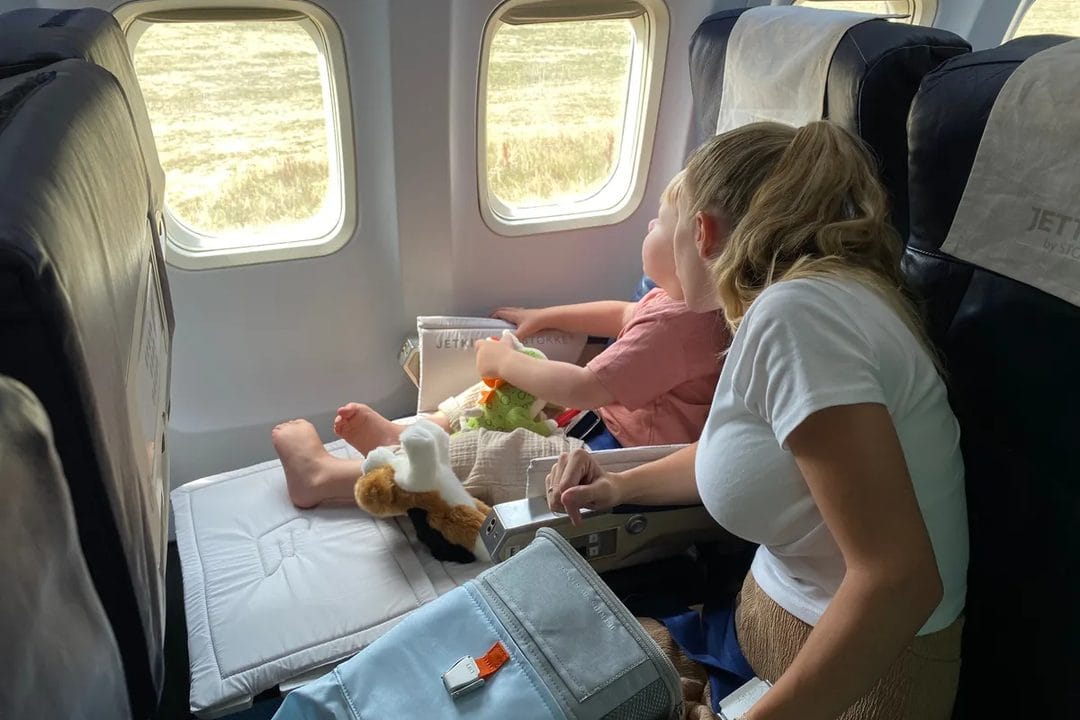
Pick the window seat, not the aisle. It keeps a wandering hand away from the drink cart and gives your child a private show — clouds, wingtips, runway lights — that buys you real minutes of quiet. Aisle seats look convenient for bathroom runs, but they also put your child directly in the path of every rolling suitcase and beverage cart on a three-hour flight.
Packing a Carry-On That Earns Its Weight
A diaper bag stuffed with everything you own is not a strategy — it's dead weight you'll dig through at 30,000 feet while a flight attendant waits for you to move your seat back up. Pack for the flight itself, not the whole trip: one outfit change per kid, a compact pack of wipes, and snacks that won't melt, crumb everywhere, or need refrigeration. Squeeze pouches, dry cereal in a reusable silicone bag, and a couple of individually wrapped items like Goldfish or fruit snacks cover most flights under four hours.
- A new small toy or activity book they haven't seen before — novelty buys twenty focused minutes that a familiar toy won't
- A reusable water bottle, empty through security, filled at a fountain past the checkpoint
- For babies: extra formula or breast milk beyond what you think you'll need, because TSA allows medically necessary liquids over 3.4 ounces, but the extra screening takes time you don't want to spend at the gate
- Compression packing cubes for spare clothes, plus a gallon Ziploc bag for anything that comes off a kid mid-flight covered in something — among the small extras worth the space
Skip the oversized "travel activity kit" marketed for exactly this trip. Most of what's inside is filler your kid will abandon in ten minutes, and it eats the carry-on space you need for the one thing that actually works: something new and quiet, without fifty small pieces to lose under seat 14C.
Getting Through Security Without the Meltdown
TSA PreCheck changes the security experience more than almost anything else on this list, and the part most parents miss is that it extends to their kids automatically. Even without a membership of their own, children 12 and under can walk through the PreCheck lane with an eligible parent or guardian — no removing shoes, no laptop out, no liquids restriction on the usual scale. If even one adult on the itinerary has PreCheck, add it to the booking and the whole family gets the faster lane. The application costs $78 for five years through the standard in-person process, and the appointment itself takes about ten minutes at most major airports. Renewal has gotten simpler too — online renewal without a new appointment is available for most existing members, removing the biggest excuse for letting it lapse before a family trip. None of this matters, though, if only one parent applies and that parent isn't the one traveling — check who's actually on the itinerary before assuming PreCheck will cover the trip.
Without PreCheck, budget real time and manage expectations before you get in line. Have kids in slip-on shoes, and keep one adult free of bags — hand off the stroller, the car seat, and the diaper bag to whoever isn't holding a squirming toddler, since juggling all three while unloading laptops into bins is how tempers snap. Gate-check strollers and car seats for free on almost every U.S. carrier; tag them at the gate, not at check-in, so you still have the stroller for the walk to the plane.
Takeoff, Landing, and the Ear-Pressure Problem
Ear pain during descent is the single most predictable meltdown trigger on a flight, and it's also the most fixable one. Because the pressure change happens fastest in the last twenty minutes before landing, time whatever you're using to counter it for that specific window, not the whole flight. Babies should nurse, take a bottle, or have a pacifier during both takeoff and — more importantly — descent, since the swallowing motion equalizes pressure the same way it does for adults chewing gum.
Gum works well for kids five and up who can be trusted not to choke on it, and Earplanes-brand filtered earplugs, around ten dollars for a pack of two, help kids who get sharp pain even with swallowing. Skip Dramamine unless a pediatrician has already cleared it for your child specifically — dosing for kids under two isn't established, and drowsy toddlers on a plane sometimes get more agitated, not less, when you're fighting their normal nap rhythm against a sedating drug.
Screens, and Being Honest About the Limits
Every parenting account that promises a screen-free flight is either lying or has a five-hour-old baby who slept the whole way. Loaded with downloaded shows — never rely on Wi-Fi, which is spotty at best and runs about $8 an hour on many carriers — a tablet is the single most effective tool for a flight over ninety minutes, and there's no version of "no screens on the plane" that survives contact with a bored four-year-old in seat 22B (ask any parent who tried it on principle once and never again). Load two or three shows they haven't seen, because a rewatch of something they've already memorized loses its hold twenty minutes in.
What actually matters is the headphones, not the tablet. Kid-sized over-ear headphones — the JBL JR300 and Puro BT2200 both run $30–$50 and cap volume at safe levels — fit better than adult headphones shrunk down, and a bad-fitting pair causes more disruption than the screen time itself. Set expectations with yourself, not just the kid: two hours of tablet on a five-hour flight isn't a parenting failure, it's a flight.
Picking Flight Times Around Naps, Not Around Fares
The cheapest flight is frequently the 6 a.m. departure, and for a toddler who naps at 1 p.m., that's also the worst possible choice — you'll have a jet-lagged, overtired kid for the first two days, instead of one who lands rested. Book around your child's actual nap window when the fare difference is under $40–$50 per ticket; the savings rarely justify the fallout. A flight that departs thirty to forty-five minutes before nap time, with the engine's white noise and dimmed cabin lighting doing half the work, comes close to a guaranteed nap for kids under three.
Red-eyes get recommended constantly for this exact reason, and they do work for some families — but only if your child normally sleeps through car rides and doesn't wake up disoriented and furious in an unfamiliar seat at 2 a.m., which some kids absolutely do. Know which kind of sleeper you have before you book one.
When the Flight Gets Delayed, or You're Flying Alone With a Lap Infant
A two-hour delay with a toddler is a different problem than a two-hour delay solo. Ask the gate agent about a stroller-friendly waiting area near the window if one exists — most large hub airports, including Atlanta and Denver, have dedicated family play areas past security, and burning energy there beats trying to keep a four-year-old still in a gate seat for two extra hours. One snack and one activity should stay in reserve, unopened, specifically for delay situations — everything else in the bag has already been used by boarding time, and a "new" item buys another thirty minutes of patience.
For a lap infant under two, know that "lap infant" means free but not restrained — the FAA doesn't require a ticketed seat for children under two, but it also doesn't recommend holding a baby through turbulence. A CARES harness, the only FAA-approved child restraint system that isn't a car seat, costs roughly $90 and is reusable for kids between 22 and 44 pounds; it turns any purchased or available seat into a proper restraint. If you're flying with an infant on your lap and traveling with another adult, buy the baby a seat if the budget allows it — a smoother flight for the price of one more ticket is, for most families, worth it.
None of this makes a flight with kids effortless, and there's always the one flight where the tablet dies, the toddler needs the bathroom two minutes after the seatbelt sign goes on, and the person in 14A is not thrilled. That flight happens to every family eventually. The difference between it ruining the whole trip and just being a rough two hours usually comes down to whether you packed the one snack you saved for exactly this moment.