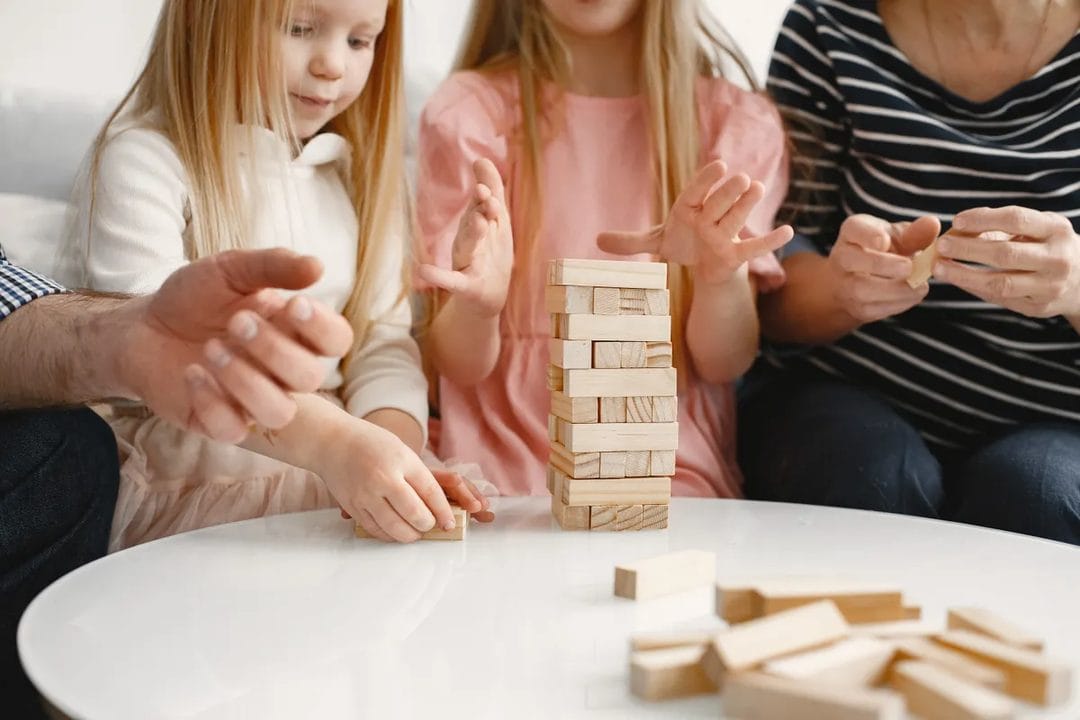
Last Tuesday at 7:15, my neighbor's eight-year-old refused to go to a birthday party sleepover because it clashed with "game night." Not a special occasion, not a holiday tradition — just the regular Tuesday when the family clears the kitchen table and plays Sequence or Bananagrams for forty-five minutes. That's the kind of loyalty most parenting advice promises and almost none delivers, and it happens because the ritual is boring in the best sense: predictable, low-stakes, and repeated often enough that kids stop questioning whether it's happening.
Why a weekly ritual works better than a special occasion
Family therapists who study routine and attachment keep landing on the same finding: kids don't bond over grand gestures, they bond over repetition. A single elaborate game night — rented arcade machines, a taco bar, the works — creates a great memory but no structure. A plain Tuesday-night ritual, kept boring and consistent, creates a structure kids can plan their week around. The University of Minnesota's Family Resiliency Center has tracked this pattern for over two decades in its family-routines research, and the consistent result is that predictability, not novelty, is what correlates with kids reporting they feel secure at home. Novelty is what adults remember; predictability is what kids depend on.
This matters more once kids hit late elementary and middle school, when their calendars start filling with travel soccer, dance rehearsals, and group chats that don't pause for dinner. A fixed weekly slot — say, Tuesday at 7:00, right after homework and before showers — survives that calendar creep because it's already claimed territory. Put it on the family calendar the same way you'd put in a piano lesson. If it competes for a slot instead of occupying a pre-claimed one, it loses within a month.
Picking games that actually fit your kids' ages
A five-year-old and a twelve-year-old cannot play the same game for forty-five straight minutes without someone melting down, so don't try to force one game to cover the whole span every week. Rotate instead. Uno and Sorry! (both under $12 at Target) work across a wide age range because the rules stay simple and luck evens out the skill gap — a six-year-old can genuinely beat a parent. Sequence ($20) and Qwirkle ($30) add a light strategy layer once kids are reading fluently, usually around age seven or eight. For a table with a teenager in the mix, Codenames ($20) or Ticket to Ride ($45–55) give older kids something that doesn't feel babyish while still being playable by a ten-year-old who's paying attention.
Keep it short enough that nobody has to leave early
- Cap it at 30–45 minutes for kids under ten — attention genuinely drops off after that.
- Pick games with a clear stopping point (a set number of rounds, a finish line) rather than open-ended ones that can drag for two hours.
- Let the youngest kid pick the game every third week, even if it's the same one every time. Being the one who chooses matters more than the choice itself.
- Skip elimination-style games for younger kids. Getting knocked out in round two and sitting there for another twenty minutes is how "game night" turns into "the night my sister cried."
Team play solves problems solo play can't
When the age gap in the family is wide — a four-year-old up against a ten-year-old — pairing the youngest with an adult on a team levels the field without anyone having to fake losing. Codenames, Pictionary, and most trivia-style games work fine as team formats even though the box says "individual play." The younger kid still gets to feel useful (guessing, drawing, picking a card) without carrying the strategic weight, and the older sibling gets a partner instead of a built-in excuse to check out. This also quietly defuses the competitive-kid problem from the section above: it's much easier to handle a loss shared with a parent than a loss that's entirely your own.
The competitive kid problem — and the honest answer
Somewhere in most families there's one kid who cannot lose gracefully, and a fair amount of parenting content pretends this is solvable with the right pep talk. It usually isn't, not quickly. What actually helps is picking games with enough luck built in — a card draw, a dice roll — that losing isn't purely a reflection of skill, and naming the feeling out loud before it turns into a tantrum ("I can see you're really frustrated that Grandpa won again"). Don't ban winning or rig the outcome so everyone ties; kids see through that within a week, and it teaches the wrong lesson entirely. Let the game be genuinely competitive. The skill you're building isn't "never feel bad about losing" — it's "survive feeling bad about losing without ruining the room for everyone else," and that takes months, not one good conversation.
What to do when the streak breaks
It will break. Someone gets sick, a work trip runs long, a kid has a project due, and three weeks go by with no game night at all. This is where most families quietly let the whole thing die — the streak feels broken, so why bother restarting? Restart anyway, on the next available Tuesday, without any announcement or apology for the gap. The ritual isn't the unbroken streak; it's the fact that it keeps coming back. Kids notice the return far more than they notice the pause, and treating the interruption as a big deal (with a "we're really going to commit this time" speech) tends to add pressure that makes the next lapse feel like a bigger failure than it is.
Board games beat the family game apps, and it's not close
There's a whole category of screen-based "family game night" apps now — trivia platforms, digital charades, phone-based drawing games — and they're fine for a group of adults at a party. For a family with kids under twelve, skip them. The screen becomes the thing everyone's looking at instead of each other, and the entire point of the ritual — eye contact, watching a six-year-old's face while she bluffs at Sneaky, Snacky Squirrel — disappears the second a phone is propped up in the middle of the table. Buy the cardboard version. It costs more up front and it's worth every dollar of the difference.
Budget and setup that won't turn it into a chore
You don't need a new game every week — five or six titles in rotation is plenty for a year, and buying one new game every couple of months (roughly $15–30 a pop from Target, Walmart, or Barnes & Noble's game section) keeps the total cost under $150 annually. Store them somewhere a seven-year-old can reach without help, because "go find the box" is where a lot of game nights die before they start. And resist the urge to make it educational. A vocabulary-building game once in a while is fine, but if every pick has to justify itself as a learning tool, it stops being the thing kids look forward to and starts being homework with dice.
Snacks help, and they don't need to be elaborate — popcorn, a bowl of grapes, whatever's already in the pantry works fine, since the food is a signal that it's time, not the main event. What doesn't help is turning game night into a production that requires planning, because a ritual that takes effort to maintain is a ritual that dies the first busy week. Keep the bar low enough that even a tired Tuesday can clear it, and the tradition survives the years when your family barely has time to breathe.